Showing posts with label elements. Show all posts
Showing posts with label elements. Show all posts
Friday, November 18, 2011
Tuesday, November 8, 2011
Happy Birthday Madame Curie!
Marie Curie was a Polish physicist and chemist who lived between 1867-1934. Together with her husband, Pierre, she discovered two new elements and studied the x-rays they emitted.


Three new elements are named!
The General Assembly of the International Union of Pure and Applied Physics (IUPAP)approved the names of three elements on Friday. Elements 110, 111 and 112 are officially named darmstadtium (Ds), roentgenium (Rg) and copernicium (Cn). Of course, these names have been unofficially listed on the periodic table since they were first proposed to the International Union of Pure and Applied Chemistry (IUPAC).
Read the full article
Friday, October 14, 2011
Monday, May 16, 2011
Chrome vs. chromium?
Have you ever wondered what the difference is between chrome and chromium? Chromium is an element. It is a hard, corrosion-resistant transition metal. Chrome, which you may see as decorative trim on cars and motorcycles or to harden tools used for industrial processes, is an electroplated layer of chromium over another metal.
Read more!

Read more!

Friday, March 11, 2011
How Elements Get Named
Do you know which element is Azote, with the symbol Az? Element names are not the same in every country. Many countries have adopted the element names that have been agreed upon by the International Union of Pure and Applied Chemistry (IUPAC). According to the IUPAC, "elements can be named after a mythological concept, a mineral, a place or country, a property, or a scientist".
Full article.
Full article.
Monday, March 7, 2011
Fun Periodic Table Facts!
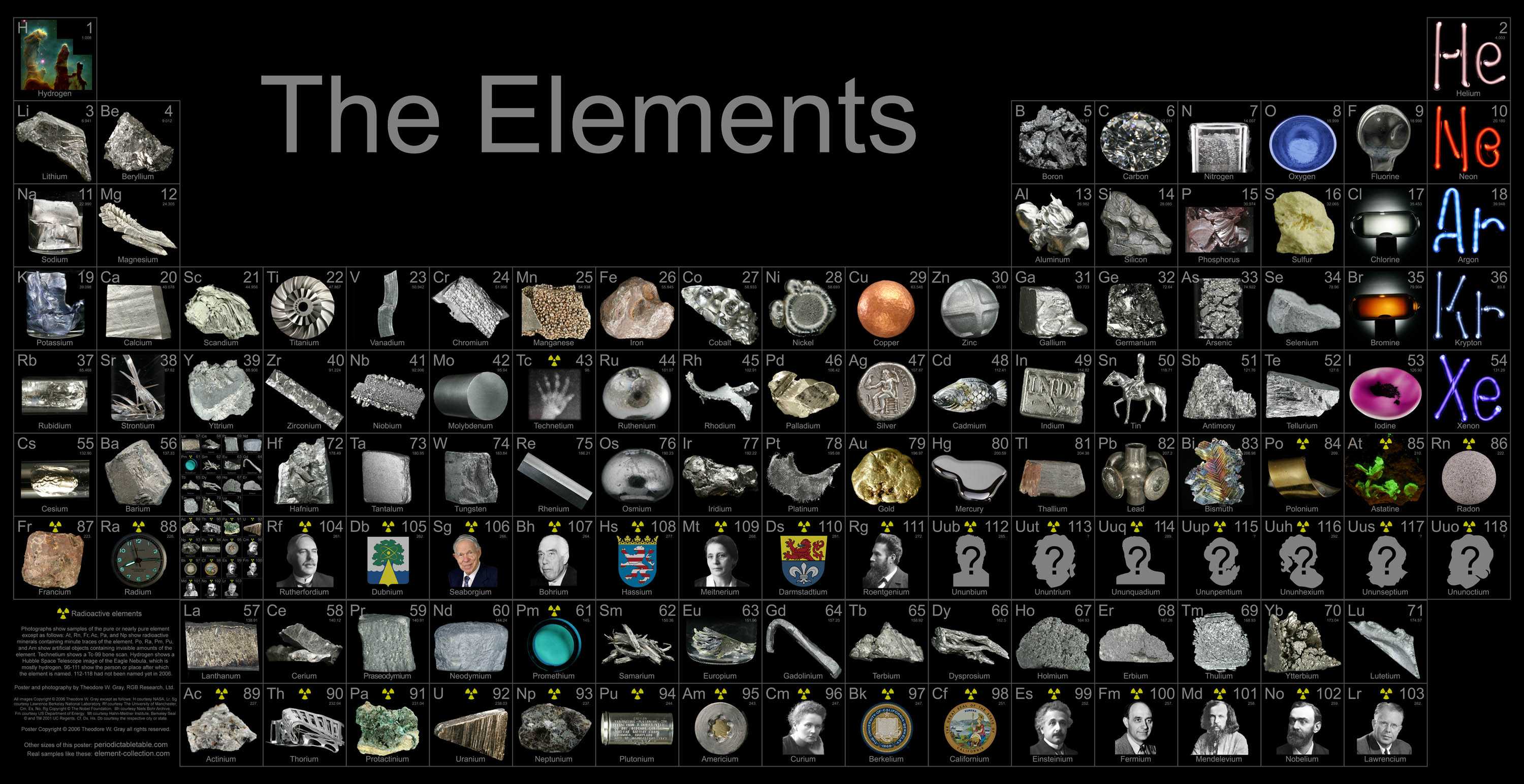
The Periodic Table is a chart which arranges the chemical elements in a useful, logical manner. Elements are listed in order of increasing atomic number, lined up so that elements which exhibit similar properties are arranged in the same row or column as each other. The Periodic Table is one of the most useful tools of chemistry and the other sciences. Here are 10 fun and interesting Periodic Table facts.

Wednesday, December 29, 2010
Fun oxygen facts
Oxygen is one of those elements you simply can't live without. You find it in the air your breathe, the water you drink, and the food you eat. Here are some quick facts about this important element. You can find more detailed information about oxygen on the oxygen facts page.
1. Animals and plants require oxygen for respiration.
2. Oxygen gas is colorless, odorless, and tasteless.
3. Liquid and solid oxygen are pale blue.
4. Oxygen is a non-metal.
5. Oxygen gas normally is the divalent molecule O2. Ozone, O3, is another form of pure oxygen.
6. Oxygen supports combustion.
7. Oxygen is paramagnetic.
8. Approximately 2/3 of the mass of the human body is oxygen.
9. Excited oxygen is responsible for the bright red and yellow-green colors of the aurora.
10. Oxygen was the atomic weight standard for the other elements until 1961 when it was replaced by carbon 12.

Keywords: elements, molecule, naming
1. Animals and plants require oxygen for respiration.
2. Oxygen gas is colorless, odorless, and tasteless.
3. Liquid and solid oxygen are pale blue.
4. Oxygen is a non-metal.
5. Oxygen gas normally is the divalent molecule O2. Ozone, O3, is another form of pure oxygen.
6. Oxygen supports combustion.
7. Oxygen is paramagnetic.
8. Approximately 2/3 of the mass of the human body is oxygen.
9. Excited oxygen is responsible for the bright red and yellow-green colors of the aurora.
10. Oxygen was the atomic weight standard for the other elements until 1961 when it was replaced by carbon 12.

Keywords: elements, molecule, naming
Tuesday, December 28, 2010
Fireworks for New Years

Wednesday, December 22, 2010

Tuesday, December 21, 2010
Tuesday, December 14, 2010
Subscribe to:
Posts (Atom)